AI & writing · 5 minute read
AI email marketing: a practical workflow for a small team
Use AI to research, draft, and improve email campaigns without losing your voice. A practical workflow with review gates, examples, and honest measurements.
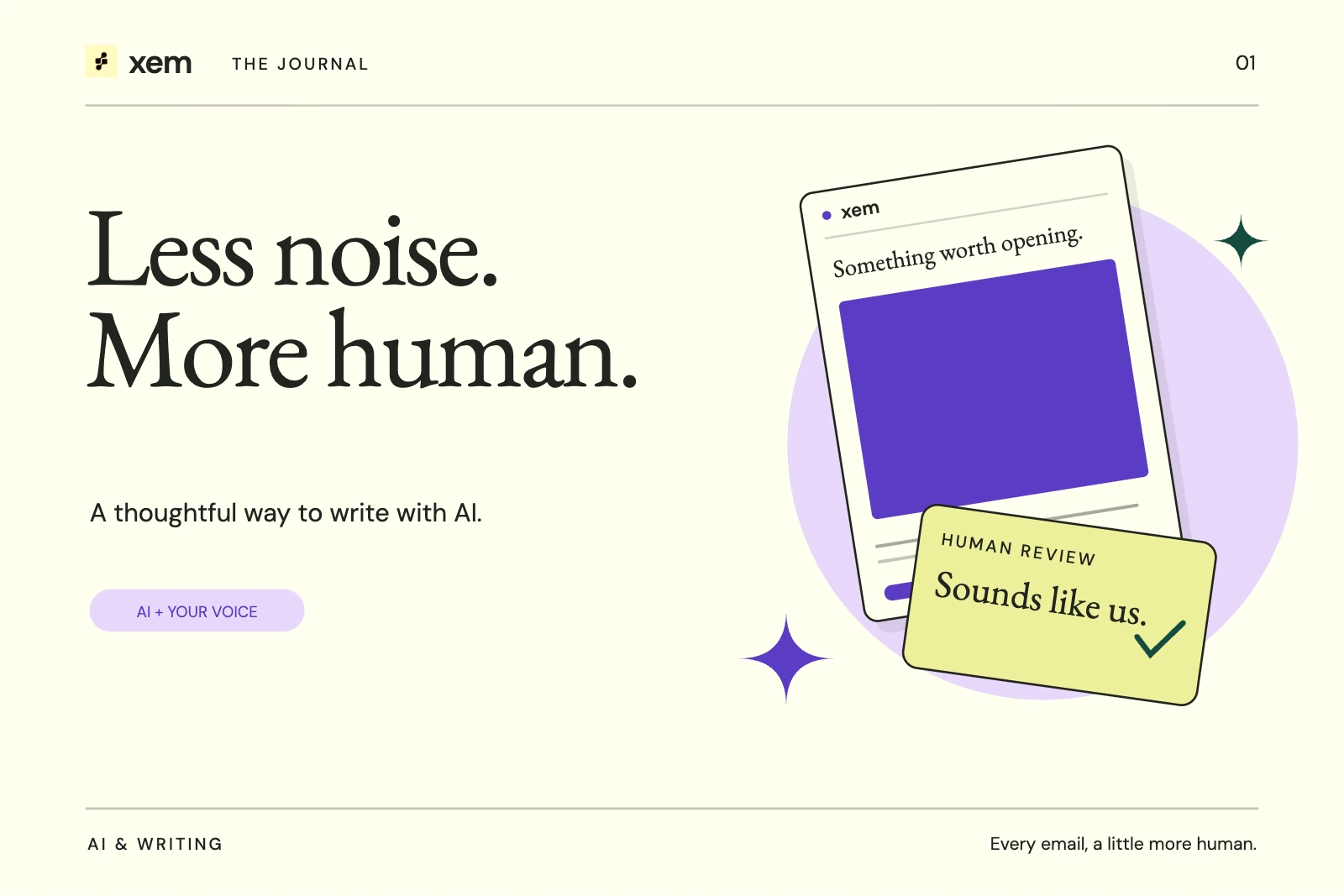
The useful question about AI email marketing is not whether a model can write an email. It can. The question is what your team should let it decide.
A model is good at producing options from a clear brief. It is less reliable at deciding whether a claim is true, a recipient expects the message, or a discount should exist. A productive workflow gives it the first job and keeps the others with people who have the context.
For a small team, that usually means using AI between the brief and the final review. You still decide the audience, the promise, and whether to send.
Start with a decision, not a prompt
Imagine a small software company releasing a shared calendar. “Write a product announcement” leaves almost everything open. The model may invent integrations, security claims, or a deadline simply because those are common in announcements.
A useful brief is more constrained:
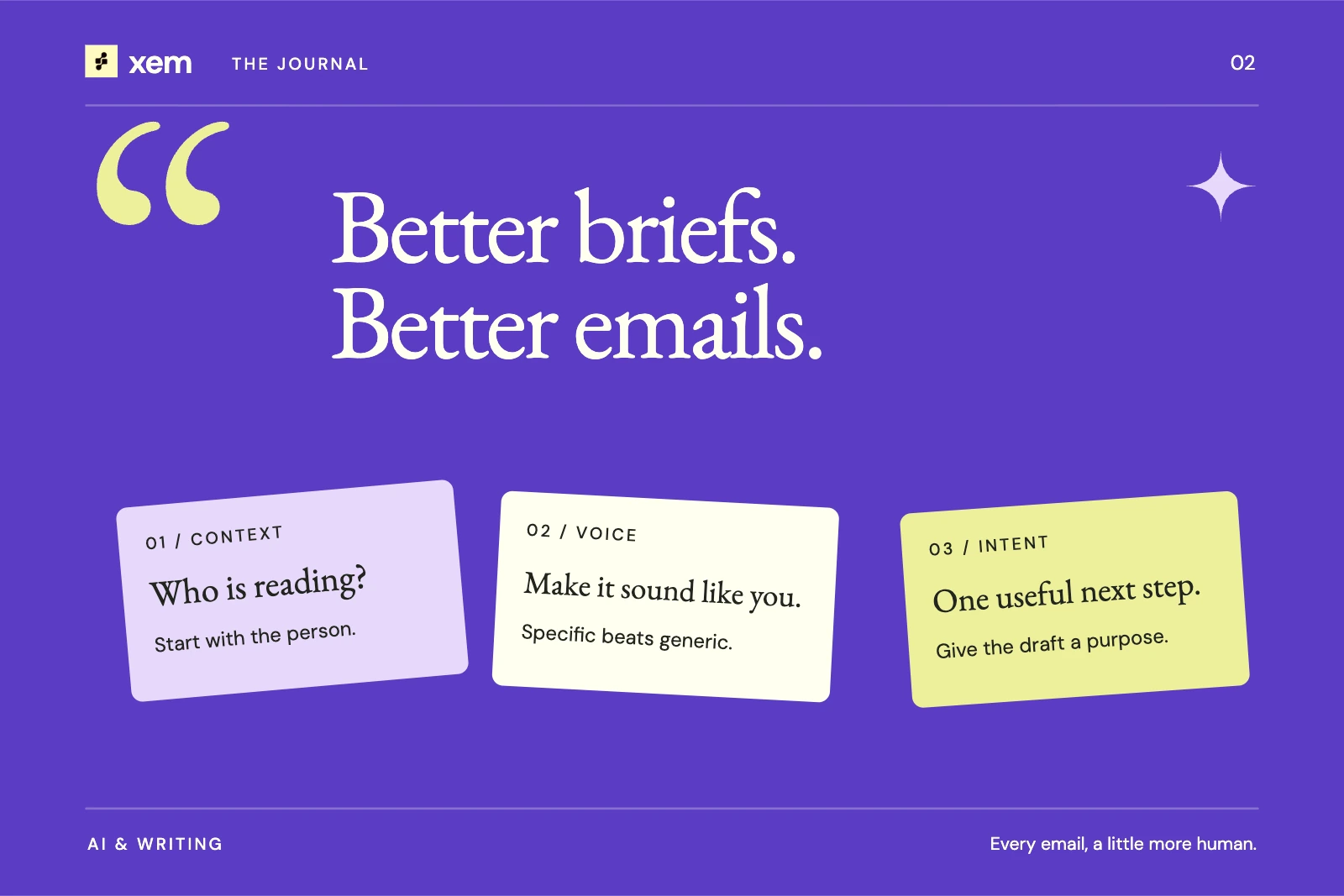
- Reader: existing customers who organize work with at least one teammate.
- Reader's problem: nobody knows which calendar has the current plan.
- Confirmed change: calendars can now be shared with named teammates.
- Limit: sharing is available only on the Team plan.
- Action: read the setup guide.
- Proof: a checked help article and an actual product screenshot.
That brief also exposes a targeting question before copy gets written. Do you know which customers work with teammates? If you do not, use a broader, truthful opening instead of implying you have watched their behavior.
Give AI a small, specific job
Ask for three approaches rather than a polished campaign in one step. For example: one version that leads with the problem, one that explains the change directly, and one that uses a short scenario.
Review the ideas first. Only then ask the model to develop the strongest option. This reduces the time spent polishing a direction that was wrong from the beginning.
A useful instruction is: “Use only the facts in this brief. Mark anything that requires evidence as [CHECK]. Do not add discounts, customer quotes, statistics, or features.” It will not guarantee accuracy, but it gives your review a clear starting point.
Keep customer lists and private conversations out of prompts unless your organization has explicitly approved that data use. You rarely need a real recipient's email address to draft a campaign. A description of the audience is usually enough.
Edit for a person with somewhere else to be
AI drafts often spend the first paragraph warming up. Delete the introduction and see whether the second paragraph works better as the opening.
Compare these two versions:
We're thrilled to announce an exciting enhancement that will transform the way your team collaborates.
Your team can now share one calendar. Invite a teammate, choose their access, and keep the plan in one place.
The second gives the reader something to understand. It also creates claims you can check. Can they invite someone? Can they choose access? Does the feature actually work that way?
Read the draft aloud. Replace phrases you would never say to a customer. Keep one main action. If an email needs three unrelated buttons, it probably needs a narrower brief or a newsletter structure.
Build the email, then review the whole experience
Copy is only one part of the message. The subject line, preview text, layout, destination page, and unsubscribe experience all affect what the reader receives.
In Xem, AI-assisted template writing can produce an editable design for the template editor. Treat the result as a draft: check the block order, image descriptions, button destinations, and small-screen layout. A visually impressive email can still be difficult to read or impossible to act on.
Use a real product screenshot when the feature itself is the point. Keep important instructions as live text. Test the message with images blocked, and review a plain-text version when your sending workflow provides one.
Before scheduling, confirm the audience and consent independently of the creative review. Approval of the wording is not approval to contact everyone in the CRM.
Measure a useful outcome
Start with one question: did this email help the right readers take the intended action?
For a product announcement, that could be visits to the setup guide followed by actual feature use. Clicks in the email platform and product activity in your application are different datasets. Connect them only through a defined, privacy-conscious measurement plan; do not assume a click proves activation.
Keep delivery indicators nearby. SMTP acceptance, failures, known complaints, and opt-outs can explain a campaign's performance more usefully than an impressive open rate. Apple Mail Privacy Protection is one reason opens need careful interpretation.
Compare AI-assisted work with your existing process on production time, factual corrections, and the campaign's chosen outcome. “We made more versions” is a workload measure, not a customer result.
A sensible first experiment
Choose one routine newsletter, not your largest launch. Write the brief yourself. Use AI for two introductions and three subject-line directions. Have one person check facts and another read the message on a phone.
Record how long the work took, what the model got wrong, and what survived into the final send. After several editions, those notes become a much more useful guide than a generic list of prompts.
If you need a starting brief, use the email prompt examples. If the process is already fast but the response is weak, revisit the audience and the offer before generating another draft.
Sources and further reading
- Mailchimp: Using AI tools in email marketing — an overview of common applications, including drafting and analysis.
- Apple: Use Mail Privacy Protection on iPhone — why opens and location signals require caution.
- Google Search: Guidance on generative AI content — useful standards for accuracy and original value when publishing AI-assisted material.
Written with AI assistance and checked against the linked sources. Examples are illustrative. Our editorial approach