AI & writing · 5 minute read
Five AI email prompts that leave room for your voice
Copy five practical AI prompts for newsletters, welcome emails, product updates, subject lines, and editing—with examples and a review checklist.
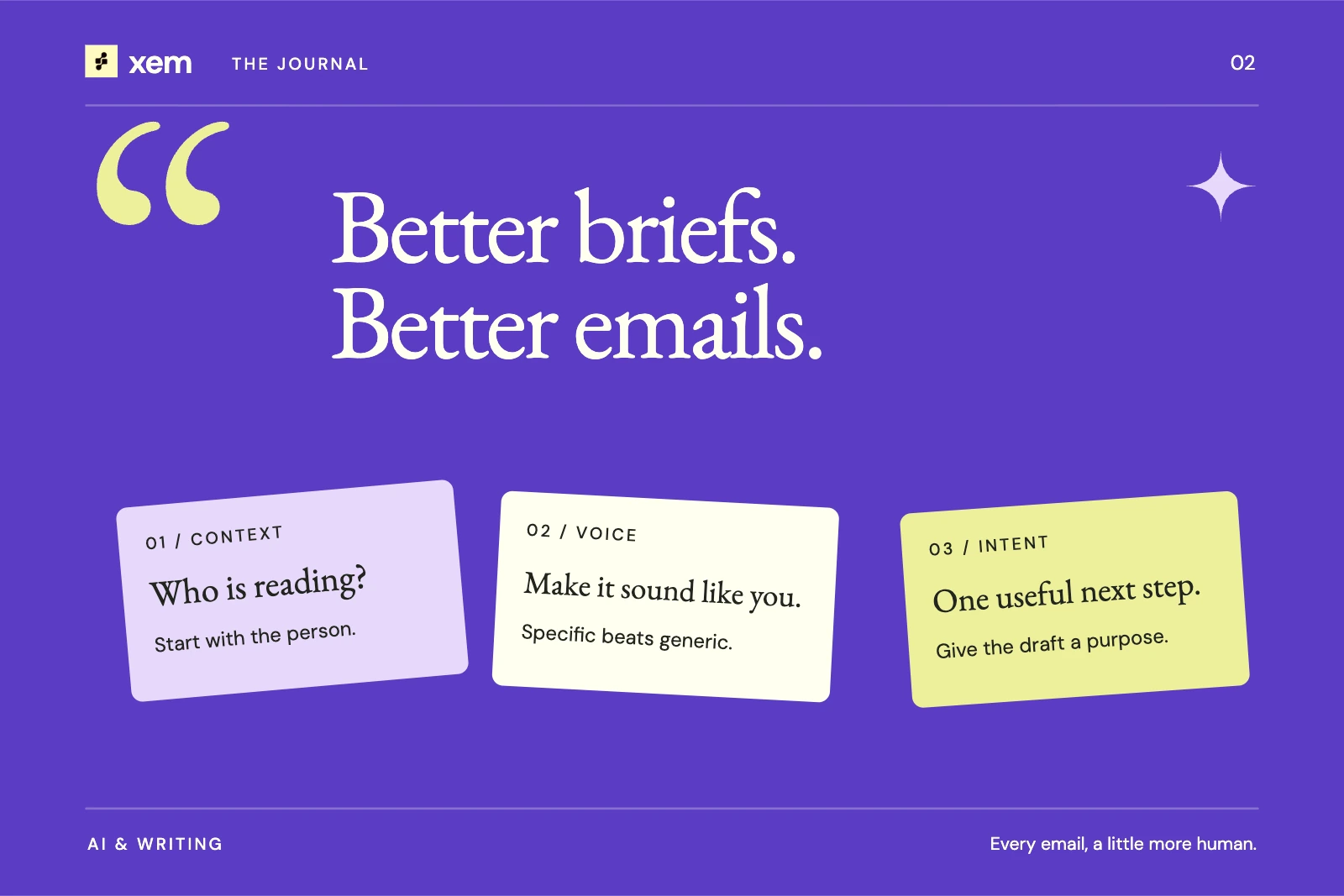
A long prompt is not necessarily a good brief. The best AI email prompts make a few things unambiguous: who the reader is, what is true, what the email should do, and what the model must leave alone.
The five prompts below are designed for editing. They produce drafts and alternatives, not messages ready to send without review. Replace the bracketed fields with verified facts. If a field is unknown, say so.
1. A newsletter with a point of view
A collection of links is easy to generate. A useful newsletter needs a reason those links belong together.
Help me draft an edition of [newsletter name].
Reader: [who subscribes and what they expect].
This edition's single theme: [theme].
My point of view: [one sentence I actually believe].
Approved sources and notes: [paste short, verified notes].

Create:
- a 60-word opening that explains why this matters now;
- three sections with a specific heading and 50–80 words each;
- one question a reader could reply to;
- a subject line and preview text that do not repeat each other.

Use only the provided facts. Link each section to its source.
Do not invent a quote, statistic, personal experience, or deadline.
Flag missing evidence with [CHECK]. Avoid hype and generic openings.
The line about your point of view matters. Without it, the draft often becomes a neutral summary that a reader could get anywhere. Your judgment is the editorial contribution.
If you send a design newsletter, for example, your theme might be “small accessibility fixes that make a large difference.” The three sections should each support that idea. A random company announcement does not belong just because it is recent.
2. A welcome email that keeps the signup promise
Draft the first email after someone signs up for [newsletter].
The signup form promised: [exact promise and frequency].
The useful resource available now: [resource and checked URL].
Sender name: [name or team]. Reply address is monitored: [yes/no].
Tone examples: [two short examples of our existing writing].

Use 120–180 words. Deliver the promised resource near the top.
Explain what arrives next and how often. Use one main button.
Mention the unsubscribe option naturally.
Do not imply a purchase, friendship, or personal familiarity.
If replies are not monitored, do not invite a reply.
Check the promise against the live form. “A weekly note” and “occasional updates” create different expectations. This is also a good time to notice whether the confirmation or download link actually works.
3. A product update without invented benefits
Write a product update for current customers.
Change: [precise description].
Who can use it: [plans, regions, roles, or restrictions].
How to start: [verified steps and URL].
Why we built it: [real customer problem, without private details].
Known limitation: [limitation, or none supplied].

Give me two versions under 160 words:
A. Lead with the change.
B. Lead with a concrete situation the reader recognizes.

Use no performance claims unless I supplied evidence.
Do not say “available to everyone” unless the eligibility says so.
Make the button label describe the destination.
Choose the version that tells the truth most clearly. A model may turn “fewer manual steps” into “save hours every week.” That is a new claim, even if it sounds harmless.
4. Subject lines that test an idea
For the approved email below, propose six subject lines.
Group them into three approaches: practical, curiosity, direct.
Explain the difference between the approaches in one sentence.
Keep the key information near the beginning.
Pair each subject with preview text that adds useful context.

No fake urgency, RE:/FWD: prefixes, invented scarcity, or clickbait.
Do not predict open rates or claim one option will perform best.
Approved email: [paste the final copy].
The point is to create meaningfully different options. “Your weekly update” and “This week's update” rarely test a useful hypothesis. “Three fixes for slow onboarding” and “Where new customers get stuck” offer different reasons to read.
If you test them, decide the outcome and evaluation window before sending. A/B testing is more useful when it answers a question than when it simply picks a winner.
5. An editor that explains its changes
Edit this email while preserving its facts and personality.
First list:
1. claims that need evidence;
2. sentences that are vague or repetitive;
3. places where the reader may not know what to do.

Then provide a revised draft and a short change log.
Keep product names, prices, dates, links, and legal language exact.
Do not add new benefits or remove meaningful limitations.
Keep deliberate quirks in the original voice unless they reduce clarity.
Email: [draft].
Use the change log as a review aid. It is not proof that the facts were preserved. Compare dates, links, amounts, and eligibility with the original source yourself.
What to check before the draft becomes a send
Read the message once as the recipient and once as the person responsible for it. On the recipient pass, ask whether the opening is relevant and the action clear. On the responsibility pass, inspect every claim, destination, permission, and promise.
Do not paste a customer export into the prompt to make the writing “more personalized.” Use an audience description or an anonymized example. Keep confidential material within your organization's approved AI setup.
Then place the copy in the actual layout. A heading that reads well in a document may wrap into five awkward lines on a phone. Xem's editable templates let you review the words and the design together; that final review still belongs to you.
Sources and further reading
- Mailchimp: Using AI tools in email marketing.
- Mailchimp: About A/B tests.
- ICO: Direct marketing guidance — context for responsible audience data use.
Written with AI assistance and checked against the linked sources. Examples are illustrative. Our editorial approach