Growth · 5 minute read
Email personalization without making people feel watched
Build useful email personalization from declared preferences and clear segments. Learn what data to use, what to avoid, and how to review AI-assisted copy.
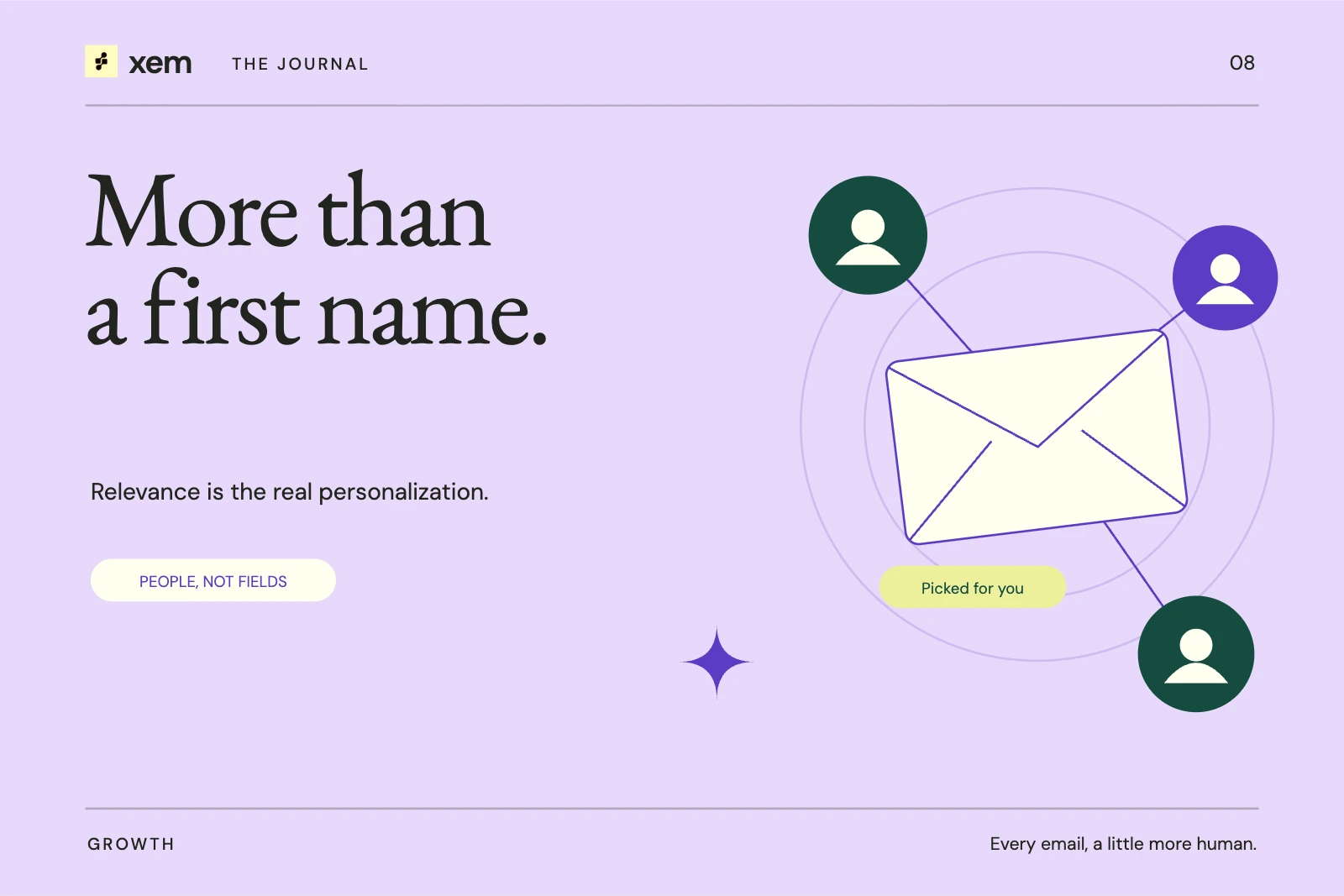
“Hi Maya” is personalization in the narrowest sense. Sending Maya a useful guide to the task she selected on your signup form is more valuable, even if the email never uses her name.
Good personalization reduces the reader's work. Poor personalization mainly demonstrates how much the sender thinks it knows.
The practical goal is relevance with a reasonable explanation. If a recipient asked, “Why did I get this email?”, your team should have a clear answer that does not depend on a guessed personality or an opaque score.
Start with declared interests
A preference someone chooses is often more useful than a behavior you infer. “I want product tutorials” gives you a clear reason to send tutorials. A single click on a pricing link can mean curiosity, comparison, an accidental tap, or a security scanner.
Use declared preferences to create a small number of understandable segments. For a software newsletter, those might be getting started, advanced workflows, and product announcements. You do not need twenty categories to begin.
Explain the choice on the form or preference interface. If a selection changes the frequency of email, say so. Make it possible to revise the choice using the controls your product actually offers.
First-party data is a description of where data comes from. It is not automatic permission to use it for every purpose. The context in which it was collected still matters.
Personalize the useful part of the email
Before changing the greeting, consider the example, the resource, and the next step.
A new user might need a three-step setup guide. An experienced user might need a detailed workflow example. Both can receive the same product announcement with a different supporting section, provided the segmentation is based on reliable information.
Here is a simple planning table:
| Known information | Reasonable adaptation | Assumption to avoid |
|---|---|---|
| Selected “beginner tutorials” | Use a short walkthrough and explain terminology | The person is inexperienced in every area. |
| Registered for a webinar | Send the promised recording and relevant follow-up | Registration means consent to unrelated daily promotions. |
| Chose a product topic | Prioritize examples about that topic | The preference will never change. |
| Uses a particular plan | Show features actually available on that plan | The person has budget or authority to upgrade. |
These are general design patterns. Confirm that your sending tool supports the required data and template conditions before building a campaign around them.
Keep a plain fallback
Personalization breaks in ordinary ways. Names are missing. Imported fields use a different format. A tag was removed. A recipient belongs to two overlapping groups.
Every variable needs a safe fallback. If a greeting becomes awkward without a name, write one that works without it. If a segment-specific section has no matching data, show a useful general version rather than an empty block.
Preview messages for several representative records, including one with missing fields. Use test data rather than exposing customer records in screenshots or prompts.
A campaign should also define what happens when segments overlap. Sending the same announcement twice because two tags matched is a data-design problem, not a creative variation.
Use AI to adapt tone, not invent a person
AI can help rewrite a confirmed message for different levels of familiarity. Give it the same verified facts and a clear description of the audience's task.
For example: “Explain this setup process for a reader who has never configured a sending domain. Define SPF once, keep the steps in order, and do not add claims about guaranteed delivery.”
Avoid prompts that ask a model to infer income, health, personality, or vulnerability from sparse behavior. Those inferences can be wrong and intrusive. They are rarely necessary to help someone use a product or understand an offer.
Do not upload a full contact export merely to make the copy sound relevant. A concise segment brief is usually sufficient. Use only AI services and data handling arrangements your organization has approved.
Keep segments understandable in the CRM
Lists, tags, and saved filters should represent concepts your team can explain. Names such as requested-product-tips are more useful than hot-lead-v3-final when someone needs to audit why a message was sent.
In Xem, use the existing audience and tag tools to organize contacts, then review the selected audience before sending. A CRM record, list membership, and permission to receive a particular message are related concepts, not interchangeable ones.
Retire old tags deliberately. If a segment exists only because of a one-time launch, decide whether it should remain a permanent preference. Document who maintains the rule and where the underlying data originates.
Evaluate relevance without overclaiming
Compare segments on the outcome the email was designed to support, while watching opt-outs and known complaints. Use the same observation window and account for different audience sizes.
A higher click rate does not prove that personalization caused the improvement. The segment may already be more engaged. If you need a causal answer, design a fair experiment within an eligible audience and keep other important variables consistent.
The simplest review question is still useful: did this version save the reader time or help them make a better decision? If the only change is a name and an exaggerated sense of familiarity, the data is doing more work than the content.
Sources and further reading
Written with AI assistance and checked against the linked sources. Examples are illustrative. Our editorial approach